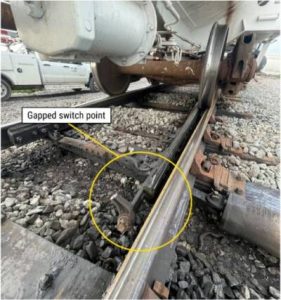
(The West Simpson spring switch following the July 18, 2025, derailment. NTSB)
A lack of coordination between Norfolk Southern’s track and signal departments contributed to a July 2025 train derailment near Browns in Edwards County that injured two railroad employees and resulted in a hazardous-material spill.
According to a report released Wednesday by the National Transportation Safety Board, the derailment occurred around 5:44 p.m. July 18th, 2025, along Norfolk Southern’s Southern West Subdivision.
Investigators determined that inadequate procedures for coordinating maintenance work between the railroad’s track and signal departments led to a switch malfunction.
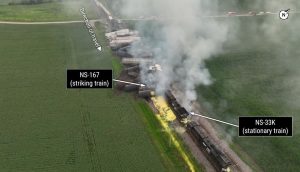
The incident occurred when 24 cars of an eastbound freight train derailed while passing over a spring switch near the Simpson siding. The derailed cars struck a westbound train that was stopped on an adjacent track.
Three tank cars carrying hazardous materials were breached, releasing molten sulfur and ethanol.
Two crew members aboard the stopped train, an engineer and an engineer trainee, were injured after jumping from the locomotive’s front platform just before a derailed tank car struck the engine.
Damage from the derailment was estimated at $9.2 million.
NTSB investigators found that a track inspector had identified problems with the switch on July 14th, four days before the derailment. Repairs were performed that day and again on July 17th, but the work was not documented in maintenance records.
During the approximately 31 hours before the accident, monitoring systems recorded 455 instances in which the switch points did not match the signal system’s indications.
A signal maintainer responded to the location on the afternoon of July 18th and made adjustments to restore the proper signal indication. However, investigators found that the employee lacked the training and equipment needed to conduct certain mechanical tests on the switch.
Less than 40 minutes after the maintainer completed his work, the switch moved out of alignment as the eastbound train passed, causing the derailment.
The NTSB concluded that better communication between the track and signal departments likely would have helped identify the underlying problem before the accident.
Following the derailment, Norfolk Southern inspected all 205 mainline spring switches across its system, replaced the switch involved in the Browns accident and implemented new inspection and documentation procedures.
The railroad also revised its policies to require coordination between maintenance departments before work is performed on spring switches.
Under the revised procedures, a switch must be taken out of service if required testing cannot be completed following maintenance.
The full investigation report is available through the National Transportation Safety Board.